What is split face stone?
Updated
Split face stone is natural stone that has been broken rather than sawn, so the face you see is the raw, uneven surface of the break. It is the texture behind stacked stone walls, ledger panels and rough stone mosaics, and it is one of the oldest ways of dressing stone there is.
How split face stone is made
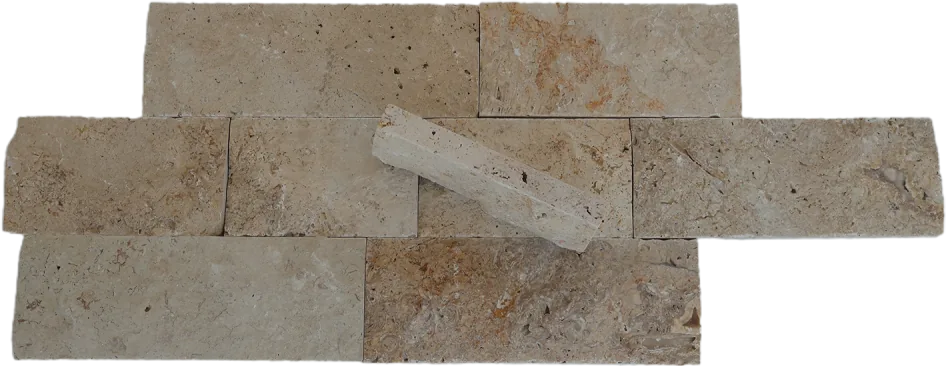
The stone starts as sawn strips of a fixed width and thickness. A hydraulic guillotine then presses a blade down onto each strip, and the stone breaks along its own grain. What is left is a face of ridges, hollows and crystal, different on every piece, with the sawn back kept flat so it can be fixed to a wall.
Because the face comes from the break and not from a tool pattern, no two pieces repeat. That is the whole reason it is used: a wall of split face stone looks built, not printed.
Which stones are split
Almost any stone that breaks cleanly can be split: travertine, marble, quartzite, slate, limestone and sandstone are all common. Each breaks differently. Travertine gives a warm, open, slightly porous face; marble breaks sharper and shows more crystal and colour; quartzite and slate break in thin, flaky layers.
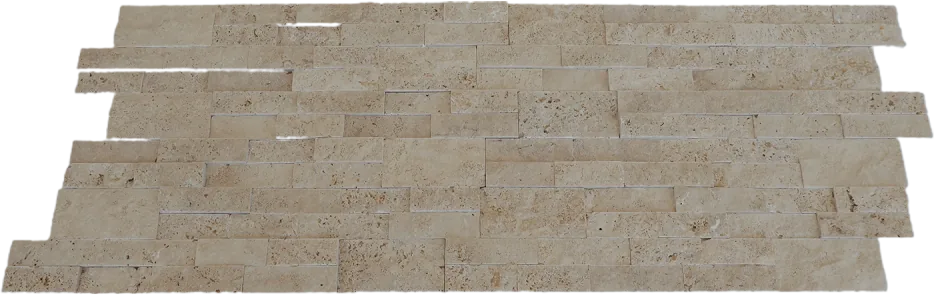
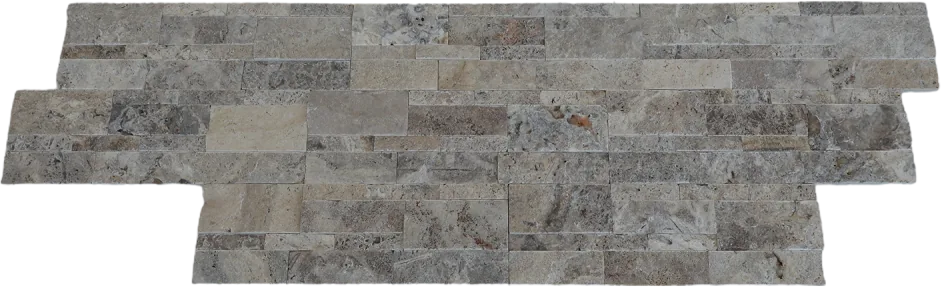
Lidamer Stone splits travertine and marble from the Denizli region of Turkey, one of the largest travertine basins in the world, in colours from Classic Light and Gold to Silver and Tundra Grey.
Split face, tumbled, honed: the finishes compared
Split face is broken and rough. Tumbled stone is cut and then rolled in a drum until the edges round off and the face softens, so it looks aged rather than broken. Honed stone is ground flat to a smooth matt surface, and polished stone is ground further until it shines.
The rougher the face, the more it catches light from the side, which is why split face is chosen for feature walls lit by a window or a downlight: the shadows are the design.
The formats it comes in
Loose strips, laid one by one in random lengths. Ours are 2.1 cm thick in widths of 10, 7.5 and 5 cm. They take the longest to lay and give the most natural result on large walls and facades.
Ledger panels, where several strips are bonded into one staggered unit, usually 6 × 24, 6 × 18 or 6 × 12 inches. This is the fastest way to build a stacked stone wall, and what most installers in the US mean when they say split face.
Mosaics, where small split face pieces are mounted on a mesh sheet for backsplashes and smaller surfaces.
Where split face stone is used
Indoors: fireplaces and chimney breasts, TV walls, feature walls in living rooms and lobbies, kitchen and bar backsplashes, columns and reception desks. Outdoors: facades, garden walls, outdoor kitchens and fire pits, pool surrounds and entrance columns.
For exterior walls in climates with hard winters, choose a dense stone, fix it with a mortar rated for exterior use, and seal it, so that water does not sit in the face and freeze. Ask your supplier whether a given colour is recommended for freeze-thaw exposure before you specify it.
Natural split face or manufactured stone veneer
Manufactured stone veneer is concrete cast in moulds and coloured to look like stone. It is lighter and often cheaper per square foot, but the pattern repeats, the colour sits on the surface and can fade or chip to grey, and it reads as an imitation up close.
Natural split face stone is the stone all the way through. It weighs more and needs a solid backing, but it does not fade, a chip shows more stone, and it keeps its value in the building. That is why it is the specification for higher-end homes, hospitality and commercial interiors.
How it is installed
Natural split face goes onto cement backer board, masonry or concrete, never straight onto drywall, with a polymer-modified thin-set mortar back-buttered onto each piece. Start at the bottom with a level line, stagger the joints, and use corner pieces on outside corners so the wall reads as solid stone.
Seal travertine and marble with a penetrating, impregnating sealer, especially on exteriors, backsplashes and around fireplaces, where soot and grease would otherwise settle in the texture.
Buying split face stone from the manufacturer
Most split face stone sold in the US is quarried and split in Turkey, China or India and reaches the shelf through an importer and a distributor. Importers, distributors and stone yards can buy it direct from the factory by the container, in the colours and formats they choose, with samples first.
If you buy for resale or for projects, send us the colours, sizes and approximate quantity you need, and we will reply with availability and a quote.